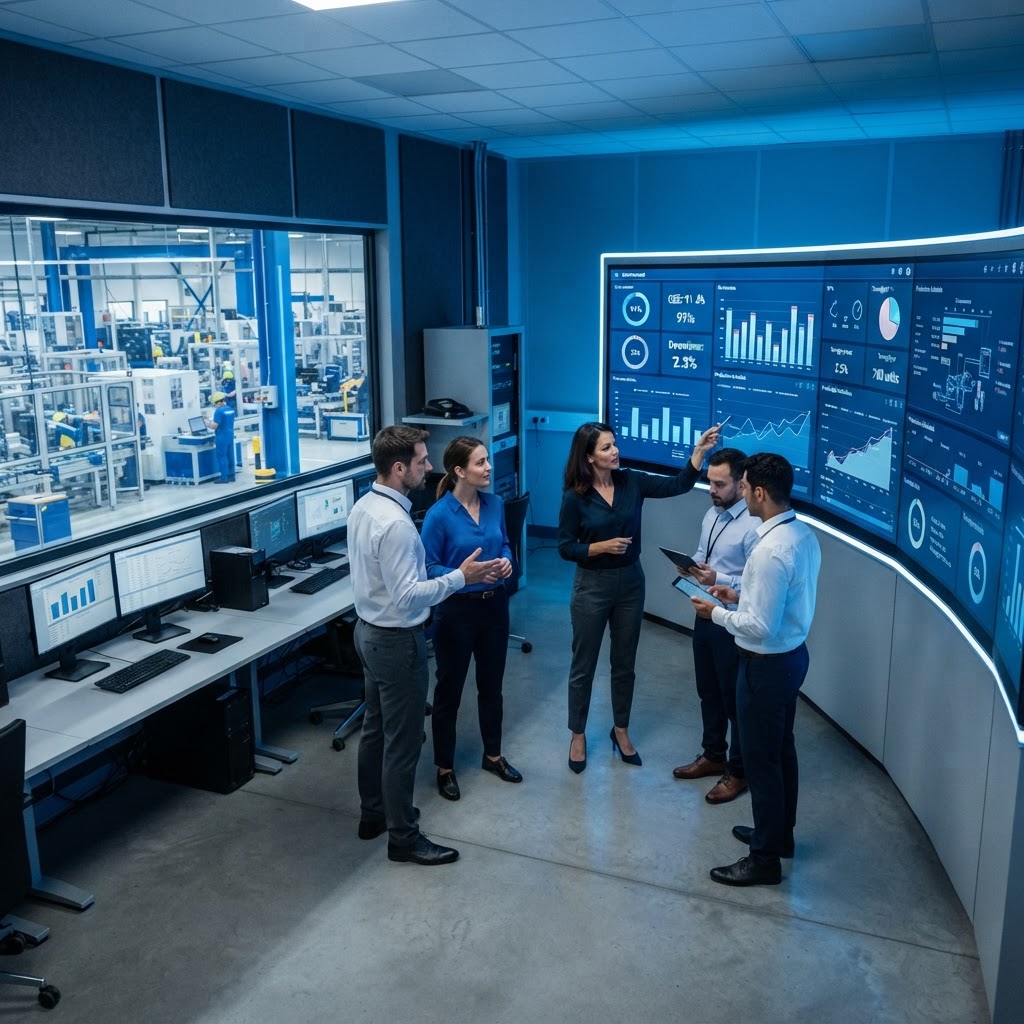
Manufacturing organizations running multiple shifts and plant locations often suffer from a particularly acute form of meeting overload: production updates, safety briefings, and cross-functional syncs multiply across time zones and shifts until calendars become unmanageable. One 500-employee industrial equipment manufacturer with facilities in three states found that middle managers were spending over 22 hours per week in meetings, leaving little time for actual plant-floor problem solving. This case study details how the company restructured its meeting culture around Microsoft Teams, the specific features it deployed, and the measurable results achieved within six months of rollout.
The Challenge: Meeting Overload Across Three Plants
Before the initiative, the manufacturer operated three separate plants that each maintained their own scheduling habits, resulting in overlapping conference calls, duplicated status meetings, and frequent last-minute travel for what should have been routine coordination. A daily production sync call connecting all three plants ran 45 minutes every morning, largely repeating figures already available in the company's ERP system, yet attendance was mandatory for over 30 managers and supervisors.
An internal survey conducted by the operations team found that 62% of recurring meetings had no written agenda, and nearly half of attendees admitted they could not clearly state the meeting's objective when asked afterward. Combined with travel time for in-person plant visits, the leadership team estimated the company was losing the equivalent of 11 full-time positions worth of productive hours annually to unnecessary meeting overhead.
Perhaps most damaging, plant supervisors reported that safety issues and production bottlenecks were often surfaced only during the next scheduled sync call rather than in real time, delaying corrective action by hours or even a full shift cycle in some cases — a risk the company's COO flagged as unacceptable during the initial diagnostic phase.
The Solution: Redesigning Meeting Culture with Teams Features
Rather than simply moving existing meetings onto Teams calls, the company's IT and operations leadership redesigned the underlying workflows. The daily cross-plant production sync was replaced with a dedicated Teams channel where each plant posted a structured status update by 7:00 AM using a standardized template, tagging relevant stakeholders with @mentions only when a decision or escalation was genuinely required.
For meetings that remained necessary, the company standardized on shared meeting agenda templates built with Loop components embedded directly in the meeting invite, ensuring every attendee could see and contribute to the agenda beforehand and add action items live during the discussion rather than waiting for follow-up emails. Meetings without a completed agenda template 24 hours in advance were automatically flagged for review by the organizer's manager.
To handle shift workers who could not attend live meetings, the company enabled Teams Premium's intelligent recap feature, which generates AI-powered meeting notes, searchable transcripts, and automatically extracted action items, allowing night-shift supervisors to review a five-minute summary instead of watching a full recording. A live Power BI dashboard embedded as a pinned tab in each plant's channel replaced the need for the daily verbal production readout entirely, showing real-time output, defect rates, and downtime figures pulled directly from plant floor sensors.
Implementation: Rollout, Governance, and Change Management
The rollout began as a six-week pilot at the largest of the three plants, led by a cross-functional team including one plant supervisor, one IT administrator, and one HR representative acting as \"Teams champions\" responsible for answering day-to-day questions and gathering feedback. This champions network proved critical in surfacing practical friction points, such as supervisors needing a simplified mobile view for posting updates between machine checks.
Governance played an equally important role as the technology itself. The company instituted a company-wide \"meeting-free Wednesday mornings\" policy enforced through a calendar add-in that blocked new meeting requests during that window, and required any meeting invitation for more than five attendees to include a stated objective in the invite body, a small but effective friction point that discouraged unnecessary meetings from being scheduled in the first place.
Within three months of the pilot expanding company-wide, weekly active usage of Teams channels for status reporting reached 92% of eligible employees, a figure leadership attributes directly to the champions network and the visible executive sponsorship from the COO, who personally used the channel structure for his own weekly updates to model the desired behavior.
Measurable Results After Six Months
Six months after full rollout, the company measured a 35% reduction in total scheduled meeting time across the three plants, based on calendar analytics. For middle managers previously spending 22 hours per week in meetings, this translated to roughly 7.7 hours per week returned to plant-floor supervision and problem-solving activities.
Beyond raw hours, the company tracked a secondary but equally significant metric: the average time between a safety or quality issue being identified and a corrective action being assigned dropped from 4.2 hours to 55 minutes, largely attributed to the shift from waiting for the next scheduled sync call to posting issues directly in the always-monitored Teams channel with immediate @mention escalation.
An internal employee satisfaction survey conducted at the six-month mark showed a 19-point increase in agreement with the statement \"I have enough time to focus on my core responsibilities,\" a notable shift for an organization that had previously struggled with chronic meeting fatigue among its supervisory staff.
\"We didn't just move our meetings onto a new platform — we questioned whether each one needed to exist at all. That mindset shift, more than the software itself, is what delivered the 35% reduction.\" — VP of Operations, industrial equipment manufacturer
Lessons Learned and Best Practices for Similar Organizations
The most important lesson from this rollout is that technology alone does not reduce meeting overload; the governance policies — mandatory agendas, meeting-free windows, and objective statements in invites — did as much work as the Teams features themselves. Organizations attempting a similar transformation should invest as much planning time in policy design as in technical configuration.
Replacing verbal status updates with live dashboards embedded directly in the collaboration tool proved to be one of the highest-leverage changes, since it eliminated an entire category of recurring meetings rather than merely shortening them. Any organization with recurring status-reporting meetings should evaluate whether a Power BI or SharePoint list-based dashboard could serve the same purpose asynchronously.
Finally, a phased rollout anchored by visible champions and executive sponsorship consistently outperforms a big-bang, company-wide launch, particularly in environments like manufacturing where shift patterns and varying digital literacy levels require more hands-on support than a typical office rollout.
This case demonstrates that meaningful productivity gains from Microsoft Teams come not from simply having access to the tool, but from deliberately redesigning workflows and governance around it. For manufacturing and other multi-site organizations struggling with meeting fatigue, the combination of async channels, embedded dashboards, and clear governance policies can deliver results comparable to or exceeding this case's 35% reduction.
LEK365 COLLAB specializes in helping multi-site organizations redesign their collaboration workflows around Microsoft Teams, from governance policy design to dashboard integration. Contact LEK365 COLLAB to schedule a meeting-culture audit and start reclaiming productive hours across your organization.